

Sun, 11 Oct
The State of South African Basketball: A Community Reality Check
For years, the South African basketball community has asked the exact same question: Why is a country with so much raw talent, world-class infrastructure, and a passionate fanbase constantly left behind on the continental stage?
The answer doesn't lie on the court. It lies in the boardroom. If you have been trying to make sense of the recent chaos surrounding tournament venues, BAL qualifications, and political infighting, here is the unfiltered truth about where our sport stands right now – and the exact structural blueprint required to fix it.
PART 1: THE CURRENT CRACKS IN THE SYSTEM
1. The "Pay to Play" Crisis at Nationals
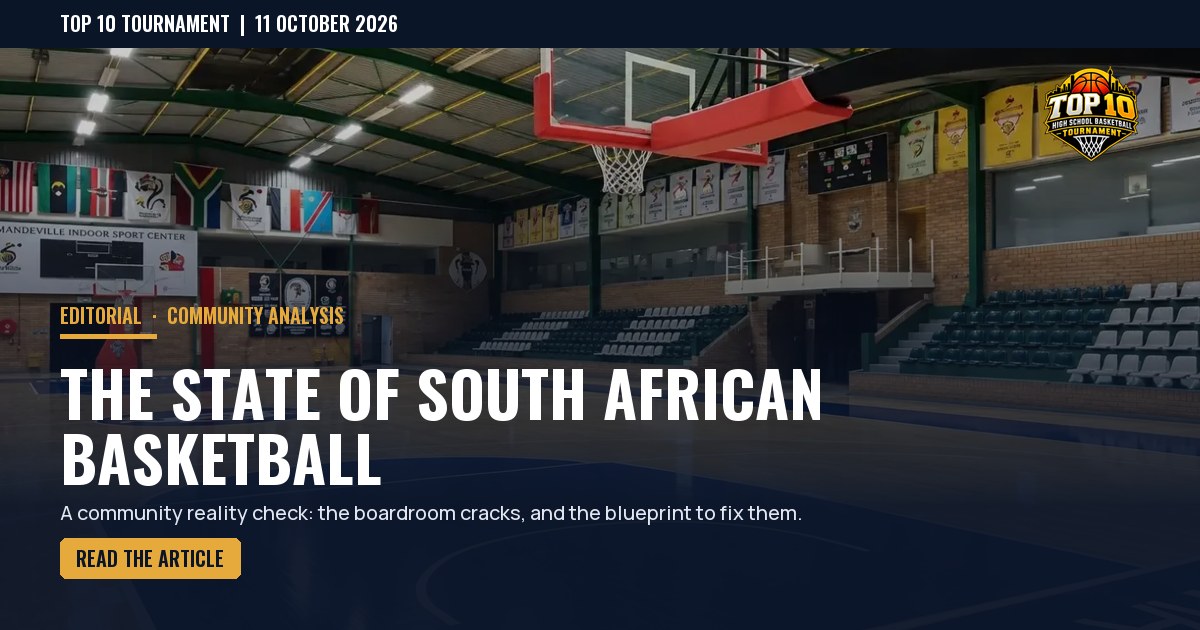
The recent 2026 National Club Championships at Mandeville exposed the severe financial strain on local clubs. While sporting merit should determine who competes for the national title, sudden schedule changes and a last-minute scramble for venues shifted the burden entirely onto the teams.
Out-of-province qualifiers faced steep, unexpected costs for travel, accommodation, and catering on short notice. Smaller, strictly merit-qualified teams were priced out, leaving the tournament to become a battle of financial survival. The championship was less about crowning the absolute best basketball talent in SA, and more about who had the immediate cash flow to meet registration deadlines.
2. The BAL Qualification Tug-of-War
The pathway to the prestigious Basketball Africa League (BAL) remains a highly volatile jurisdiction battle. On one side stands Basketball South Africa (BSA), which holds the constitutional right recognised by FIBA to endorse SA’s representative to the Road to BAL. On the other side is the Basketball National League (BNL), housing elite, well-funded franchises that field the highest tier of professional rosters.
Because these two bodies have historically failed to align, the local qualification path is fragmented. Clubs are trapped in a system of shifting eligibility criteria, disputed player clearances, and sudden regulatory changes. When the administrative bodies weaponise the rulebook, the teams bear the financial and logistical fallout.
3. The Power Struggle: FIBA Africa, DSAC, and SASCOC
At the absolute top tier, the sport is in an institutional gridlock. Following severe governance failures and missing financial records, the Department of Sport, Arts and Culture (DSAC) formally withdrew state recognition and funding from the BSA leadership.
Yet, the board remains intact due to a legal loophole: while the Minister can pull government money, only SASCOC holds the constitutional power to officially suspend a sports federation. This defiance has triggered a direct intervention from FIBA Africa.
FIBA has deployed a representative on the ground to work alongside DSAC and SASCOC on a mandatory recovery roadmap to force a clean slate. However, local basketball associations have already raised red flags, warning that entrenched provincial delegates are attempting to rush a "quick vote" to simply shuffle the same leadership figures into a new structure under a different name.
PART 2: THE ROADMAP FORWARD – FOUR KEY PILLARS FOR REAL CHANGE
To truly rebuild the sport, the upcoming FIBA Africa restructuring cannot just be a cosmetic change of leadership. It must systematically overhaul the entire operational model through four critical interventions:
1. A Unified League Architecture & Professional Standards
The disconnect between the amateur club structure (BSA) and the elite franchise tier (BNL) creates a fragmented, toxic ecosystem where players and sponsors never know which pathway matters.
The Solution: We need a single, synchronised national competition pyramid. The BNL should be officially recognised as the premier professional tier, underpinned by a clear promotion-relegation or licensing system connected to regional club championships. Roster registration, contract standards, and player transfer windows must be digitised and managed under a centralised, transparent database to end the annual eligibility disputes before continental qualifiers.
2. A Decentralised Commercial Model
For decades, local basketball has suffered from "head-office syndrome" – where a centralised national board hoards control of sponsorships and grants, leaving provincial and district structures with zero budget to host sustainable leagues.
The Solution: We must decentralise financial power. The national body must operate primarily as a regulatory and high-performance umbrella, while districts are empowered with the commercial tools to secure localised corporate partnerships. This ensures that grassroots leagues can afford court bookings, referee fees, and basic equipment without relying on emergency bailouts from parents or players.
3. Professionalising Grassroots & School Systems
South Africa has massive schoolboy and schoolgirl basketball participation (especially across private and top-tier public schools), but this talent pool exists in a complete silo. It is entirely disconnected from club structures, meaning thousands of elite teenagers stop playing the moment they matriculate.
The Solution: Mandate a formalised "School-to-Club" transition pathway. Every registered senior club should be constitutionally required to link with local school circuits, running structured under-14, under-16, and under-18 development academies. Concurrently, a standardised national coaching and refereeing certification programme must be rolled out freely to school teachers to drastically elevate the baseline tactical level of the youth game.
4. Radical Governance Transparency & Forensic Auditing
A "quick vote" organised by existing provincial delegates will simply install the same compromised networks under a new federation name. Without fixing the corrupt voting structures, history will repeat itself.
The Solution: Before a single vote is cast in the new elections, a rigorous, independent forensic audit of all active provincial voting structures must be finalised. Voting blocs must be strictly weighted based on verified, active local leagues – not ghost clubs created on paper to manipulate elections. Financial transparency must be institutionalised by publishing audited quarterly balance sheets publicly on an open-access federation portal, proving exactly where state funds, FIBA grants, and corporate sponsorships are being spent.
The Bottom Line
South African basketball cannot move forward until its foundation is rebuilt. Until FIBA's restructuring process successfully establishes an independent, audited, and transparent national federation, our local leagues and elite clubs will continue to navigate a fragmented landscape.
It is time for the community – players, coaches, fans, and administrators – to reject quick-fix compromises and demand structural accountability. Our players train too hard, and our fans care too much, to let this hustle go to waste.